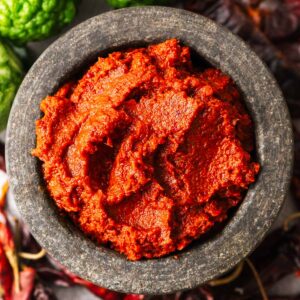
Red Thai curry paste is an essential ingredient in authentic Thai red curry. And it's easy to make your own curry paste for flavourful homemade curries that taste like they're from the best Thai restaurants!
Yield½ cup
Servings12
Ingredients
- 30 dried chiles de arbol *
- 20 white peppercorns , or black
- 1 tablespoon finely diced galangal * , or ginger
- 2 stalks lemongrass , tough outer leaves and base removed, then finely sliced
- ¼ cup finely diced shallot , about 1 small shallot
- 6 cloves garlic , peeled
- 1 tablespoon sliced cilantro roots , or stems
- 2 teaspoons finely grated makrut lime zest *
- 2 teaspoons shrimp paste
- 1 teaspoon salt
Instructions
- Destem the chillies, break them in two, and shake out as many seeds and membranes as possible – this reduces the spiciness and makes it easier to blend. Place the chillies in a heat-proof bowl and cover with boiling water. Leave to soak for 30 minutes.
- Add the peppercorns to a small food processor or spice grinder and pulse until coarsely ground.
- Add the diced galangal and sliced lemongrass. Blitz until you have a fibrous yet homogeneous blend, scraping down the sides as needed.
- Add the diced shallot, garlic, and cilantro root (or stem). Blitz until you have a wet, mostly smooth, paste. Stop to scrape down the sides and mix as needed.
- Drain the chillies and add them to the grinder – in batches if needed. Blitz until you have a smooth, bright red paste.
- Add the remaining ingredients and blend into a smooth, thick red paste.
- Refrigerate the curry paste in an airtight container for up to 5 days or freeze in portions for up to 3 months.
Notes
- The type of dried chilli determines the spiciness of your curry paste. The traditional choice is dried Thai red spur chillies – but they're not readily available. Instead, I use deseeded chile de arbol. The generic dried red chillies from Asian grocery stores also work well. Or, opt for dried guajillo for a milder chilli paste.
- If you can't find fresh or brine-pickled galangal, use fresh ginger instead.
- limes (also called kaffir limes) are green wrinkly limes used in Thai cuisine. A single lime is typically enough for 2 teaspoons (10 grams) of kaffir lime zest.
- The authentic Thai curry paste method requires a pestle and mortar but requires lots of arm strength and patience. Instead, I use the small food processor/spice grinder attached to my Bamix immersion blender and add the ingredients in batches. You can use a spice grinder, small food processor or high-speed blender. But if you use a standard-sized food processor, you'll need to double the recipe.
- To make Thai red curry, stir-fry your authentic red curry paste in oil, then add coconut milk, fish sauce, and palm sugar. Cook your veggies or meat in the fragrant curry sauce. See my Thai fish curry recipe for step-by-step instructions.